By Jim Garamone American Forces Press Service ABOARD THE USNS COMFORT : The USNS Comfort cast off lines this morning in Baltimore to begin the race to aid the people of Haiti.
"At this juncture the leadership of USNS Comfort is making every effort to expedite our arrival in Haiti, said Navy Lt. Bashon Mann, the ship's public affairs officer. "The expected arrival date is Thursday (Jan. 21,) but we are moving as fast as we safely can to hasten the arrival in Haiti to begin delivering patient care." The Comfort is a large white ship with red crosses painted on it. Haiti was a stop on its last deployment in 2009 and that is helping the medical professionals now as they head to the nation. "We have people in contact with people in Haiti planning on how we will be able to help when we arrive," Mann said. Medical planners are using the transit time to flesh out plans. The medical staff and crew are working to be able to immediately start delivering care once the ship arrives in Haitian waters. Two helicopters will fly aboard the ship later this afternoon. The choppers will join a growing fleet of aircraft operating to aid Haiti. Red Cross officials fear that the magnitude 7 earthquake that struck Jan. 12 killed between 40,000 and 50,000 people. Many thousands have been injured and most hospitals in Port-au-Prince, the nation's capital and epicenter of the quake, have been destroyed. The comfort brings 19 operating rooms, and intensive-care facility, and hundreds of beds to the humanitarian mission. Getting the Comfort ready was a rush job, to say the least. The Navy notified most of the personnel that they would deploy on Jan. 13. Buses brought the medical staff to the ship yesterday, and sailors searched for their berths, muster stations and workspaces until late in the night. Cranes lifted medical supplies, equipment and foodstuffs onto the helipad, and sailors lifted and heaved to store the supplies even as the ship began moving. (Issued on : Jan 16, 2010) | ||
| | ||
|
Sunday, January 17, 2010
USNS Comfort Begins Race to Haiti


Saturday, January 16, 2010
West Virginia Air Guard Operates Staging Area
By Air Force Staff Sgt. Sherree Grebenstein Special to American Forces Press Service MARTINSBURG, W.Va.: Airmen with the West Virginia Air National Guard's 167th Airlift Wing are working around the clock here in an effort to get critical life-saving supplies to Haiti's earthquake victims.
Sixteen tractor-trailers and eight box trucks ordered by the Department of Health and Human Services brought the critical cargo to the 167th Airlift Wing to be loaded onto aircraft bound for Haiti's capital. The trucks were loaded with medical supplies and equipment, generators, air-conditioning units, tents, food and water. Air Force Col. Roger L. Nye, 167th Airlift Wing commander, said the C-5 Galaxy aircraft stationed at the base in Martinsburg aren't being used to fly the supplies and equipment to Haiti due to the transport jet's massive size. "A C-5 would shut down the airfield at Port-au-Prince," he said. Jerry Hill, a Health and Human Services logistics manager, has a 180,000-square foot warehouse that houses emergency medical supplies. "When disasters happen, [the department] is responsible for getting critical assets to the medical professionals in the field," he said. When it came to finding a location to stage operations for the massive humanitarian airlift, Hill didn't have to look far. As the deployment officer for the 167th Airlift Wing's aeromedical evacuation squadron, Hillknows the wing's efficient reputation and capabilities. "Within 12 hours, we had trucks on site here," he said. "I expected great support from the unit, and that is exactly what we got. When the flag goes up, these guys really shine." Hill estimated that more than a million pounds of supplies will be flown to Haiti from the base. "The base was chosen to support this mission due to the ideal proximity to the national capital region," said Air Force Maj. Melissa Shade, 167th Airlift Wing chief of staff. "Most recently, emergency responders were staged at Martinsburg to support the 2009 presidential inauguration. Since the base began the transformation to house C-5s in 2002, the spacious hangars offer ideal conditions for these types of operations." Nye lauded the efforts of his unit's airmen as they worked in tandem to ensure that critical supplies were loaded onto aircraft as quickly as possible for the desperate earthquake victims in Haiti. The colonel said airmen from the unit eventually may be tasked to support the humanitarian efforts downrange as well. The 167th Airlift Wing has alerted two aeromedical evacuation crews for possible deployment to Haiti. These crews will assess, treat and transport critically wounded patients. About 700 airmen currently are involved with relief effort operations at the Martinsburg air base. Air Force Staff Sgt. Chris Crowell, a cargo specialist with the wing's Logistics readiness squadron, said he is proud to serve on his first humanitarian mission by helping to palletize supplies for aircraft waiting on the base's runway. "'Mountaineer Pride Worldwide' is our motto," he said of the West Virginia Air National Guard. Crowell said his heart goes out to the earthquake victims. "I know they didn't have that much to begin with," he said. "We'll try to do what we can to help. It will be worth it in the end." Many 167th Airlift Wing members responsible for palletizing and loading the supplies on the Mississippi Air National Guard C-17 aircraft had just returned from a week-long deployment to Gulfport, Miss. More than 400 of the base's airmen were in Mississippi to complete an operational readiness exercise, which is a test of a unit's ability to prepare its members for overseas deployments. Air Force Capt. Bill Brohard, officer in charge of the wing's small air terminal, said the real-world humanitarian mission allows airmen to test their mettle. "We're hoping to put our skills to good use," he said. (Air Force Staff Sgt. Sherree Grebenstein serves with the West Virginia National Guard. Air Force Lt. Col. Michael Cadle, state public affairs officer for the West Virginia National Guard, contributed to this story.) (Issued on Jan.15, 2010) | ||
| Related Sites: Special Report: Haiti Earthquake Relief | ||
| |

Kissing his wife
 | |
| U.S. Navy Electronics Technician 2nd Class (SW) William Boyd kisses his wife, Marie, before getting underway aboard the Whidbey Island-class dock landing ship USS Gunston Hall (LSD 44), Jan. 15, 2010, at Joint Expeditionary Base Little Creek-Fort Story in Virginia Beach, Va. Gunston Hall Sailors are deploying to Haiti to provide humanitarian assistance and disaster response in the aftermath of Haiti's devastating earthquake. (DoD photo by Mass Communication Specialist 3rd Class John Suits, U.S. Navy/RELEASED) | |
 | |
Pennsylvania Guard to Broadcast to Haitians
By Airman 1st Class Claire Behney
Special to American Forces Press Service
HARRISBURG, Pa., : The Pennsylvania National Guard is sending a uniquely equipped plane to Haiti to provide radio and television broadcasts to keep the people of the earthquake-stricken nation informed as rescue and humanitarian missions continue.
About 50 airmen and three C-130 aircraft assigned to the 193rd Special Operations Wing will provide rapid communications response capabilities to all of Hispaniola, which comprises Haiti and the Dominican Republic.
Two of the aircraft are cargo aircraft. The third, named Commando Solo, is an airborne radio and television station that will provide important information to the Haitian people as U.S. and international search and rescue and humanitarian aid missions continue.
In what he described as an "unprecedented humanitarian mission," Gov. Edward G. Rendell said that the Pennsylvania Air National Guard had been called out to support the Air Force Special Operations Command mission in Haiti.
One of the aircraft departed late on Jan. 14, the other two aircraft left Middletown, Pa., today.
"Our National Guard is honored to extend a helping hand to the people of Haiti. I am proud of these dedicated airmen, who are always ready to answer the call of duty, whether it is for combat missions or to aid those in need," said Army Maj. Gen. Jessica L. Wright, the adjutant general of the Pennsylvania National Guard.
The 193rd was last called to serve in Haiti more than a decade ago. In 1994, Commando Solo was used to broadcast radio and television messages to the citizens and leaders of Haiti during Operation Uphold Democracy. This is, however, the first humanitarian mission of its type for the wing.
(Issued on : Jan. 15, 2010)
(Airman 1st Class Claire Behney is assigned to the Pennsylvania National Guard.)
Related Sites:
Special Report: Devastation in Haiti
Special to American Forces Press Service
HARRISBURG, Pa., : The Pennsylvania National Guard is sending a uniquely equipped plane to Haiti to provide radio and television broadcasts to keep the people of the earthquake-stricken nation informed as rescue and humanitarian missions continue.
|

Two of the aircraft are cargo aircraft. The third, named Commando Solo, is an airborne radio and television station that will provide important information to the Haitian people as U.S. and international search and rescue and humanitarian aid missions continue.
In what he described as an "unprecedented humanitarian mission," Gov. Edward G. Rendell said that the Pennsylvania Air National Guard had been called out to support the Air Force Special Operations Command mission in Haiti.
One of the aircraft departed late on Jan. 14, the other two aircraft left Middletown, Pa., today.
"Our National Guard is honored to extend a helping hand to the people of Haiti. I am proud of these dedicated airmen, who are always ready to answer the call of duty, whether it is for combat missions or to aid those in need," said Army Maj. Gen. Jessica L. Wright, the adjutant general of the Pennsylvania National Guard.
The 193rd was last called to serve in Haiti more than a decade ago. In 1994, Commando Solo was used to broadcast radio and television messages to the citizens and leaders of Haiti during Operation Uphold Democracy. This is, however, the first humanitarian mission of its type for the wing.
(Issued on : Jan. 15, 2010)
(Airman 1st Class Claire Behney is assigned to the Pennsylvania National Guard.)
Related Sites:
Special Report: Devastation in Haiti
An aerial view

Reconstruction Team Joins Clearing Operation
By Air Force Master Sgt. Sarah R. Webb Special to American Forces Press Service GHAZNI PROVINCE, Afghanistan : More than 100 members from the provincial reconstruction team and coalition forces participated in a clearing operation with Afghan soldiers in the Gelan district here Jan. 6 and 7.
The coalition forces included soldiers from Poland's 2nd Operational Mentoring Liaison Team, explosive ordnance disposal personnel from Task Force Paladin and a route-clearance team from Forward Operating Base Sherona. "Since the beginning of my tour, we've conducted six missions with the [Afghan army]," said Lt. Col. Romon Utracki, commander of the Polish team, assigned to Forward Operating Base Warrior. On those missions, he added, the Afghan soldiers detained six people and found a weapons cache. To make the operation as challenging as possible, the Afghan soldiers chose specific targets because of the high recent level of enemy harassment of the local population. "It is our job to provide training for the [Afghan soldiers] who work in this theater," Utracki said. "We accomplished our mission today. They decided their targets, created a plan and stuck with it. They did a good job." During the operation, the Polish team established close supporting positions while the other elements secured the outer perimeter. Once the Afghan soldiers had cleared and secured the areas, civil affairs members from the provincial reconstruction team met with village elders to ask about residents' needs and gauge the relationships between the villagers and the Afghan security forces. (Issued on : Jan. 15, 2010) (Air Force Master Sgt. Sarah R. Webb serves in the provincial reconstruction team public affairs office in Afghanistan's Ghazni province.) | ||||
| Related Sites: U.S. Forces Afghanistan U.S. Forces Afghanistan on Twitter U.S. Forces Afghanistan on Facebook U.S. Forces Afghanistan on YouTube NATO International Security Assistance Force | ||||
|


Friday, January 15, 2010
Officials Urge More Care for Caregivers
By Elaine Wilson of American Forces Press Service
WASHINGTON : The military needs to step up efforts to head off compassion fatigue among its caregivers, a National Guard official said here yesterday.
"I do think not enough of it is being paid attention to by the active or reserve component," said Public Health Service Capt. Joan Hunter, director of psychological health for the National Guard Bureau.
Hunter spoke at the 2010 Suicide Prevention Conference here sponsored by the Defense and Veterans Affairs departments. She defined compassion fatigue as the emotional residue or strain of exposure of working with patients recovering from traumatic events. Warning signs, she explained, include a decrease in performance, inattention to self-care, irritability and anger, absenteeism, and conflicts with workers and peers.
"It starts out in a very insidious way, but can escalate very quickly," she noted.
Hunter said she's already seen evidence of it within the Guard's new psychological health program. Through the program, officials have placed a provider, called a state director of psychological health, in every state and territory. Directors work with community health providers to build relationships and networks that will offer psychological health services for Guard members and their families, according to the National Guard's Psychological Health Program Web site.
"In the first year that we've become operational, I've already seen compassion fatigue among the licensed providers that are providing these services to our soldiers and airmen in the National Guard," she said.
Hunter cautioned leaders not to overload these providers, who already are saddled with an extensive workload.
"I think very quickly, if we're not careful in this program, we're going to move on the scale from compassion fatigue to burnout," she said.
Hunter also noted the importance of caring for the 5,000-plus Guard volunteers, many of whom are geographically dispersed.
"As citizen-soldiers and citizen-airmen, we are very tied to our communities and many of us are remote," she said. In the Army National Guard alone, 6,400 members are the only soldiers within their ZIP code, she noted.
Compassion fatigue has touched chaplains, military family program coordinators, state family program directors and sexual assault and response recovery coordinators, Hunter said.
Caregivers often set themselves up for overload by taking on too much, J. Elizabeth Perkins, director of psychological health for the Michigan National Guard, said at the conference yesterday.
"We think we can do it all," she said, "that we can take on just one more thing. The reality of that is there's always one more, and we'll never be able to accomplish what we need to without taking the time and giving ourselves the permission to say, 'No, I need to take some time so I can then help others.'"
To illustrate, Perkins recalled a conversation she had with a state chaplain. "He was reminding his staff about the importance of self-care. I turned to him and I said, 'Well sir, that's wonderful, but when was the last time you took a vacation?' It had been three years."
Caregivers are adept at offering other people recommendations to help them cope, "but we don't then do that for ourselves."
It's vital to build personal resiliency, she said. Maintaining a healthy diet, exercise, adequate sleep, social support and setting boundaries can help, she added.
Perkins noted that the Defense Department-funded Millennium Cohort Study initially has indicated that daily physical activity reduces the risk of developing symptoms of post-traumatic stress disorder. Perkins also cautioned caregivers to be aware of multiple stressors, such as work and personal problems, which can lead to a stress overload.
"We also need to be asking ourselves, 'What else is going on in your life?' And this is not just as helping professionals, but also for those servicemembers with whom we are working," she said.
People at risk of cumulative stress may be confronting mental or physical concerns, for instance, along with marital and family issues. These significant stressors not only raise the risk of illness, but possibly suicide, she said.
Perkins described several effective methods for stress relief including meditation, journaling, deep breathing, the importance of doing nothing and guided imagery. Along with personal de-stressing methods, Hunter said, the Guard is taking big-picture steps to help.
Leaders plan to take the "goals and intent" of the Army's Comprehensive Soldier Fitness program and translate it into a program that works for the Guard. The Army program is a psychological fitness initiative designed to build resilience in soldiers. They also plan to leverage senior enlisted personnel in the hopes of increasing face-to-face contact with junior enlisted members. The Guard doesn't have enough licensed providers to meet the demands of Guard members, she noted.
"I think our counselors and our mental health providers are the best asset we have in the Department of Defense and in [Veterans Affairs]," Hunter said. "And I think it's our responsibility and our duty to protect them and to provide them with the tools they need to get the job done." (Issued on : Jan. 14, 2010)
Related Sites:
National Guard Bureau Psychological Health Program
Defense Centers of Excellence for Psychological Health and Traumatic Brain Injury
Special Report: Defense Centers of Excellence
WASHINGTON : The military needs to step up efforts to head off compassion fatigue among its caregivers, a National Guard official said here yesterday.
|

Hunter spoke at the 2010 Suicide Prevention Conference here sponsored by the Defense and Veterans Affairs departments. She defined compassion fatigue as the emotional residue or strain of exposure of working with patients recovering from traumatic events. Warning signs, she explained, include a decrease in performance, inattention to self-care, irritability and anger, absenteeism, and conflicts with workers and peers.
"It starts out in a very insidious way, but can escalate very quickly," she noted.
Hunter said she's already seen evidence of it within the Guard's new psychological health program. Through the program, officials have placed a provider, called a state director of psychological health, in every state and territory. Directors work with community health providers to build relationships and networks that will offer psychological health services for Guard members and their families, according to the National Guard's Psychological Health Program Web site.
"In the first year that we've become operational, I've already seen compassion fatigue among the licensed providers that are providing these services to our soldiers and airmen in the National Guard," she said.
Hunter cautioned leaders not to overload these providers, who already are saddled with an extensive workload.
"I think very quickly, if we're not careful in this program, we're going to move on the scale from compassion fatigue to burnout," she said.
Hunter also noted the importance of caring for the 5,000-plus Guard volunteers, many of whom are geographically dispersed.
"As citizen-soldiers and citizen-airmen, we are very tied to our communities and many of us are remote," she said. In the Army National Guard alone, 6,400 members are the only soldiers within their ZIP code, she noted.
Compassion fatigue has touched chaplains, military family program coordinators, state family program directors and sexual assault and response recovery coordinators, Hunter said.
Caregivers often set themselves up for overload by taking on too much, J. Elizabeth Perkins, director of psychological health for the Michigan National Guard, said at the conference yesterday.
"We think we can do it all," she said, "that we can take on just one more thing. The reality of that is there's always one more, and we'll never be able to accomplish what we need to without taking the time and giving ourselves the permission to say, 'No, I need to take some time so I can then help others.'"
To illustrate, Perkins recalled a conversation she had with a state chaplain. "He was reminding his staff about the importance of self-care. I turned to him and I said, 'Well sir, that's wonderful, but when was the last time you took a vacation?' It had been three years."
Caregivers are adept at offering other people recommendations to help them cope, "but we don't then do that for ourselves."
It's vital to build personal resiliency, she said. Maintaining a healthy diet, exercise, adequate sleep, social support and setting boundaries can help, she added.
Perkins noted that the Defense Department-funded Millennium Cohort Study initially has indicated that daily physical activity reduces the risk of developing symptoms of post-traumatic stress disorder. Perkins also cautioned caregivers to be aware of multiple stressors, such as work and personal problems, which can lead to a stress overload.
"We also need to be asking ourselves, 'What else is going on in your life?' And this is not just as helping professionals, but also for those servicemembers with whom we are working," she said.
People at risk of cumulative stress may be confronting mental or physical concerns, for instance, along with marital and family issues. These significant stressors not only raise the risk of illness, but possibly suicide, she said.
Perkins described several effective methods for stress relief including meditation, journaling, deep breathing, the importance of doing nothing and guided imagery. Along with personal de-stressing methods, Hunter said, the Guard is taking big-picture steps to help.
Leaders plan to take the "goals and intent" of the Army's Comprehensive Soldier Fitness program and translate it into a program that works for the Guard. The Army program is a psychological fitness initiative designed to build resilience in soldiers. They also plan to leverage senior enlisted personnel in the hopes of increasing face-to-face contact with junior enlisted members. The Guard doesn't have enough licensed providers to meet the demands of Guard members, she noted.
"I think our counselors and our mental health providers are the best asset we have in the Department of Defense and in [Veterans Affairs]," Hunter said. "And I think it's our responsibility and our duty to protect them and to provide them with the tools they need to get the job done." (Issued on : Jan. 14, 2010)
Related Sites:
National Guard Bureau Psychological Health Program
Defense Centers of Excellence for Psychological Health and Traumatic Brain Injury
Special Report: Defense Centers of Excellence
Thursday, January 14, 2010
Navy’s first female aircraft handler--Regina Rogers

Hillary Rodham Clinton views the names of lost U.S. Sailors

Secretary of State Hillary Rodham Clinton views the names of U.S. Sailors lost in the attack on Pearl Harbor during her visit to the USS Arizona Memorial in Pearl Harbor, Hawaii, Jan. 12, 2010. While in Hawaii, Clinton met with Japanese Foreign Minister Katsuya Okada to discuss the movement of Marine Corps Air Station Futenma, the expansion of the Japanese and U.S. security alliance, the war in Afghanistan and North Korea’s nuclear programs. Clinton is on a trip through the Pacific region to strengthen ties with partner nations and will stop in Australia, New Zealand and Papua New Guinea. (DoD photo by Tech. Sgt. Cohen A. Young, U.S. Air Force/Released)
Face of Defense: Former British Soldier Joins U.S. Army
By Army Sgt. Teddy Wade
Special to American Forces Press Service
KUNAR PROVINCE, Afghanistan : Army Spc. Robert Sumner looks like any other American soldier. But when he speaks, his thick British accent separates him from the crowd.
Serving here with the 10th Mountain Division's 1st Battalion, 32nd Infantry Regiment, Sumner realizes his road from the British Isles to the mountains of Afghanistan was a long and interesting path.
Sumner said he always dreamed of being a soldier, and after graduating from high school in 1996, he enlisted in the British army, serving in Cyprus, Hong Kong, Kosovo, Bosnia and Northern Ireland until 2003.
In 2004, he began working for a private security firm, and he continued working there until 2005, when he came to the United States for the first time to attend training in Arkansas. There, he met and married his wife, Katherine.
For two years, Sumner lived with his new wife in his new home. But he wanted to give something back to his new country, and in July 2007, he enlisted in the U.S. Army.
"I enlisted in the U.S. Army because I wanted to do something for this country that has given me so much," Sumner said. "When people ask me in the future, 'What have you done for this country?' I'll have something to say."
Sumner joined the 10th Mountain Division, based in Fort Drum, N.Y., after asking one of his drill sergeants in basic training which unit is the most deployed in the Army.
"When I was going to Fort Drum, I was all excited about going over there," Sumner said. "I imagined, 'A mountain division. They should have a lot of mountains to climb, and I'm an avid hiker. That should be fun.' But soon after I arrived, I realized that Fort Drum is flat, and that they just get a lot of snow."
Before deploying in January 2009, Sumner was serving as an infantryman in the reconnaissance platoon. But he suffered an injury during training and was removed from that position.
"I had a foot injury," Sumner said. "An infantryman's feet are very important. So our sergeant major decided to pull me out from that duty and assigned me to the personal security detachment, mostly due to my experience as a contractor. When I arrived in Afghanistan, they placed me in the PSD as temporary duty, but three months later, I was still doing it even though I was fully recovered."
Sumner uses his experience in personal security operations as a PSD team leader for Army Lt. Col. Frederick O'Donnell, the battalion commander.
"The first time I met Sumner was back in Fort Drum," O'Donnell said. "Back then, he was assigned to Combat Company. He was a private first class leading an entire squad during a live-fire exercise. I was impressed just by watching his execution; he displayed a lot of ability. It is funny to me, because he called some of his soldiers 'blokes,' just like they do back in England. The way he gave the commands reflected his background and experience."
Army Staff Sgt. Mike Cruz, noncommissioned officer in charge of the personal security detachment and Sumner's squad leader, also had praise for Sumner.
"I really appreciate his expertise as a soldier," Cruz said. "He is a great asset for the team, and he helps me train the other guys in the PSD."
Sumner noted the difference in the core of the loyalty professed by soldiers in the two armies in which he's served.
"British soldiers often said they fight for the queen," he said. "Over here in America, we fight for the American people. American people have been so good to me.
"When I went back to the U.S. for my rest and recreation," he continued, "people were clapping at the airport and offered to pay for my meal. I was so amazed. Nobody does that in England. Maybe they appreciate my service over there, but they just showed it in a different way. I'm now 31 years old, but I've still got a long way to go. I love the Army, and I feel that I can do so much more."
(Army Sgt. Teddy Wade serves with the 55th Signal Company.)
Related Sites:
U.S. Forces Afghanistan
U.S. Forces Afghanistan on Twitter
U.S. Forces Afghanistan on Facebook
U.S. Forces Afghanistan on YouTube
NATO International Security Assistance Force
Special to American Forces Press Service
KUNAR PROVINCE, Afghanistan : Army Spc. Robert Sumner looks like any other American soldier. But when he speaks, his thick British accent separates him from the crowd.
|

Sumner said he always dreamed of being a soldier, and after graduating from high school in 1996, he enlisted in the British army, serving in Cyprus, Hong Kong, Kosovo, Bosnia and Northern Ireland until 2003.
In 2004, he began working for a private security firm, and he continued working there until 2005, when he came to the United States for the first time to attend training in Arkansas. There, he met and married his wife, Katherine.
For two years, Sumner lived with his new wife in his new home. But he wanted to give something back to his new country, and in July 2007, he enlisted in the U.S. Army.
"I enlisted in the U.S. Army because I wanted to do something for this country that has given me so much," Sumner said. "When people ask me in the future, 'What have you done for this country?' I'll have something to say."
Sumner joined the 10th Mountain Division, based in Fort Drum, N.Y., after asking one of his drill sergeants in basic training which unit is the most deployed in the Army.
"When I was going to Fort Drum, I was all excited about going over there," Sumner said. "I imagined, 'A mountain division. They should have a lot of mountains to climb, and I'm an avid hiker. That should be fun.' But soon after I arrived, I realized that Fort Drum is flat, and that they just get a lot of snow."
Before deploying in January 2009, Sumner was serving as an infantryman in the reconnaissance platoon. But he suffered an injury during training and was removed from that position.
"I had a foot injury," Sumner said. "An infantryman's feet are very important. So our sergeant major decided to pull me out from that duty and assigned me to the personal security detachment, mostly due to my experience as a contractor. When I arrived in Afghanistan, they placed me in the PSD as temporary duty, but three months later, I was still doing it even though I was fully recovered."
Sumner uses his experience in personal security operations as a PSD team leader for Army Lt. Col. Frederick O'Donnell, the battalion commander.
"The first time I met Sumner was back in Fort Drum," O'Donnell said. "Back then, he was assigned to Combat Company. He was a private first class leading an entire squad during a live-fire exercise. I was impressed just by watching his execution; he displayed a lot of ability. It is funny to me, because he called some of his soldiers 'blokes,' just like they do back in England. The way he gave the commands reflected his background and experience."
Army Staff Sgt. Mike Cruz, noncommissioned officer in charge of the personal security detachment and Sumner's squad leader, also had praise for Sumner.
"I really appreciate his expertise as a soldier," Cruz said. "He is a great asset for the team, and he helps me train the other guys in the PSD."
Sumner noted the difference in the core of the loyalty professed by soldiers in the two armies in which he's served.
"British soldiers often said they fight for the queen," he said. "Over here in America, we fight for the American people. American people have been so good to me.
"When I went back to the U.S. for my rest and recreation," he continued, "people were clapping at the airport and offered to pay for my meal. I was so amazed. Nobody does that in England. Maybe they appreciate my service over there, but they just showed it in a different way. I'm now 31 years old, but I've still got a long way to go. I love the Army, and I feel that I can do so much more."
(Army Sgt. Teddy Wade serves with the 55th Signal Company.)
Related Sites:
U.S. Forces Afghanistan
U.S. Forces Afghanistan on Twitter
U.S. Forces Afghanistan on Facebook
U.S. Forces Afghanistan on YouTube
NATO International Security Assistance Force
Tuesday, January 12, 2010
U.S. Navy aviation

U.S. Navy aviation ordnancement assigned to the "Warhawks" of Strike Fighter Squadron 97 load ordnance onto an F/A-18C Hornet aircraft aboard the aircraft carrier USS Nimitz (CVN 68) while under way in the North Arabian Sea Jan. 9, 2010. The Nimitz Carrier Strike Group is on deployment to the U.S. 5th Fleet area of operations. (DoD photo by Mass Communication Specialist 3rd Class James Mitchell, U.S. Navy/Released)
Meeting in Afghanistan

Afghan Minister of Defense Gen. Abdul Rahim Wardak addresses a group of Afghan and U.S. officials during a meeting in Afghanistan Jan. 9, 2010, to sign a memorandum of understanding concerning the ministry assuming responsibility for a newly-completed detention facility in the Parwan province of Afghanistan. According to the memorandum, the Ministry of Defense will perform the custodial role and management functions for the transition of the detention facility until turning over these duties to the Ministry of Justice, Central Prisons Directorate. (DoD photo by Chief Petty Officer Robert W. Garnand, U.S. Navy/Released)
Check of fuel

U.S. Air Force Staff Sgt. Craig Wayman, a fuels laboratory technician with the 380th Expeditionary Logistics Readiness Squadron, checks a sample of fuel from a fuels truck during operations at an undisclosed base in Southwest Asia Jan. 6, 2010. The 380th ELRS fuels management flight pumps millions of gallons of fuel every month in support of Operations Iraqi and Enduring Freedom and Combined Joint Task Force-Horn of Africa. Wayman is deployed from the 9th LRS at Eglin Air Force Base, Fla. (DoD photo by Tech. Sgt. Scott T. Sturkol, U.S. Air Force/Released)
Face of Defense: Airman Follows Famous Uncle
By Mike Joseph Special to American Forces Press Service LACKLAND AIR FORCE BASE, Texas : When Airman Christopher Platte decided to join the Air Force last year, he didn't know he would be following in famous footsteps.
BMT graduation was the first time since he was an infant that Platte had been with his famous uncle, who helped break down racial and educational barriers by becoming one of the first African American officers trained and commissioned in the newly reopened Air Force pilot training program at Randolph Air Force Base, Texas, in the 1940s. The younger Platte found out about his uncle after telling his family he wanted to join the Air Force. He first spoke with his great uncle in November 2008, he said. "I talked to my mother about [joining the Air Force] and she said, 'Oh, by the way, you have a great uncle who is a Tuskegee Airman,'" Platte recalled. "I had no idea," he added. "I think that it's going to be a great motivation for me to take it a step higher now that I know where I come from. Even if I decide not to be a pilot, it's motivation to be the best I can be in the Air Force." The elder Platte served 18 years in the Air Force and trained more than 400 African American airmen to fly solo and pilot specialized military aircraft. Captain Platte's brother -- Christopher Platte's grandfather -- was also a Tuskegee Airman. Captain Platte has received many honors including an honorary doctorate in public service from Tuskegee University in 2006, and the Congressional Gold Medal in 2007. Retired from Bell Helicopter Textron Co. and living in North Texas, Platte and other Tuskegee Airmen travel the country telling their stories. A modest man who stays involved in community service, the elder Platte said he wasn't out to break down barriers; he only wanted to fly. "It was something I wanted to do," he said. "It was just like getting a toy. I didn't think about the segregation part of it. I wasn't interfered with, so I really enjoyed it." Captain Platte's return to Lackland AFB for his great nephew's graduation was the first time he had been back since his own BMT nearly 50 years ago. And, as Airman Platte begins his military career, he's entering as a survival, evasion, resistance and escape specialist. He, too, started down a different trail. After all, how many airmen begin their career with an Eagle Scout Court of Honor the day before BMT graduation? "It was an interesting experience. It was not a traditional court of honor," he said about the Dec. 10 ceremony. Col. William Mott V, the 37th Training Wing commander, presided over the event and presented Platte with his Eagle Scout award. The two days of activities were enough to make a mother proud. "I don't think there are words to describe how proud I am," said Platte's mother, Marilyn Wright. "He really didn't have any idea the legacy he was stepping into. Since he was six, he's been saying, 'I want to fly planes; I want to be in the air!'" "Honestly, I tried to discourage him, but it's in his heart to be an airman," she said. "Now he's fulfilling a dream." (Issued on: Jan. 11, 2010) (Mike Joseph works for 37th Training Wing public affairs.) | ||

Friday, January 08, 2010
Humanitarian aid supplies in Taktehpol, Afghanistan

U.S. Soldiers with Bear Troop, 8th Squadron, 1st Cavalry Regiment carry humanitarian aid supplies in Taktehpol, Afghanistan, Jan. 4, 2010. (DoD photo by Tech. Sgt. Francisco V. Govea II, U.S. Air Force/Released)
Thursday, January 07, 2010
F-15s Scramble to Escort Hawaiian Airlines Flight
American Forces Press Service
SALEM, Ore., : Two Oregon Air National Guard F-15 fighters, under the direction of North American Aerospace Defense Command, intercepted Hawaiian Airlines Flight 39 yesterday after a passenger caused a disturbance on the plane and the pilot decided to return the aircraft to Portland.

The F-15s, stationed at Portland Air National Guard Base, escorted the aircraft until it landed at Portland International Airport without incident at about 1:15 p.m. PST, where the plane was met by law enforcement and the Transportation Security Administration.
The Oregon National Guard's 142nd Fighter Wing guards the skies from northern California to the Canadian border on 24-hour alert as part of the North American Air Defense system. The F-15 fighter jets become a federal asset once alerted, placing them under presidential authority, officials said.
(From an Oregon National Guard news release.)
Related Sites:
Oregon National Guard
North American Aerospace Defense Command
SALEM, Ore., : Two Oregon Air National Guard F-15 fighters, under the direction of North American Aerospace Defense Command, intercepted Hawaiian Airlines Flight 39 yesterday after a passenger caused a disturbance on the plane and the pilot decided to return the aircraft to Portland.

The Oregon National Guard's 142nd Fighter Wing guards the skies from northern California to the Canadian border on 24-hour alert as part of the North American Air Defense system. The F-15 fighter jets become a federal asset once alerted, placing them under presidential authority, officials said.
(From an Oregon National Guard news release.)
Related Sites:
Oregon National Guard
North American Aerospace Defense Command
Monday, January 04, 2010
Marines Focus on Target Identification
By Marine Corps Lance Cpl. James W. Clark
Special to American Forces Press Service

CAMP DWYER, Afghanistan : Adjusting his body armor, a designated marksman with Bravo Company, 1st Battalion, 6th Marine Regiment, tracked the progress of a patrol of Marines from his perch atop a rocky hillside. The marksman followed the line of tan figures as they plodded along toward the platoon attack course at Range 3 here Jan. 2.
The patrol rounded a bend and approached a cluster of barriers that represented the first set of houses the Marines would encounter. After a brief sputter of chatter across the radio, the patrol separated into squads, then further into four-man fire teams. Each element pushed toward a predetermined objective, but also had to remain cognizant of the situation as it developed and targets were identified.
As the patrol neared the houses and responded to simulated enemy fire, the Marines had to determine which targets were hostile and which were friendly as they prepared to return fire.

The exercise simulated a patrol taking on an enemy position without the use of indirect fire, due to the risk of indirect fire causing civilian casualties. This forced the Marines to rely on accurate small-arms fire, explained Marine Corps 1st Lt. Mark A. Greenlief, the company's executive officer. The purpose of the training exercise is to further develop the Marines' ability to quickly acquire enemy targets and engage them, while minimizing the risk to civilians, he said.
"Coordination is essential at the individual Marine level, and all the way up," Greenleif said. "The goal is to teach that the kinetic solution isn't always the best one."
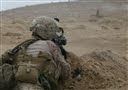
As the Marines moved through the course, they came across silhouettes marked by different colors meant to indicate a hostile or friendly target.
"The exercise gave us the chance to distinguish between targets in the heat of the moment," said Marine Corps Lance Cpl. Brandon C. McConnell, a team leader. "It's pretty easy [during training]. In the real world, it won't be like this, and you'll have only a few seconds to make that judgment. The biggest challenge is trying to determine who's friendly and who isn't."
McCono was with the battalion on its last deployment to Afghanistan as a part of the 24th Marine Expeditionary Unit, described the challenge of making careful and good decisions in the middle of combat.
You have to maintain control," he said. "You're getting shot at by one person, and you want to just shoot back at everyone, but you know you can't."
The success of counterinsurgency operations relies heavily on the ability of Marines and sailors to reduce civilian casualties, Greenlief said, which requires each Marine to take great care in acquiring every target.
(Marine Corps Lance Cpl. James W. Clark serves in the 1st Marine Division's Regimental Combat Team 7 public affairs office.)
Special to American Forces Press Service

The patrol rounded a bend and approached a cluster of barriers that represented the first set of houses the Marines would encounter. After a brief sputter of chatter across the radio, the patrol separated into squads, then further into four-man fire teams. Each element pushed toward a predetermined objective, but also had to remain cognizant of the situation as it developed and targets were identified.
As the patrol neared the houses and responded to simulated enemy fire, the Marines had to determine which targets were hostile and which were friendly as they prepared to return fire.

"Coordination is essential at the individual Marine level, and all the way up," Greenleif said. "The goal is to teach that the kinetic solution isn't always the best one."

"The exercise gave us the chance to distinguish between targets in the heat of the moment," said Marine Corps Lance Cpl. Brandon C. McConnell, a team leader. "It's pretty easy [during training]. In the real world, it won't be like this, and you'll have only a few seconds to make that judgment. The biggest challenge is trying to determine who's friendly and who isn't."
McCono was with the battalion on its last deployment to Afghanistan as a part of the 24th Marine Expeditionary Unit, described the challenge of making careful and good decisions in the middle of combat.
You have to maintain control," he said. "You're getting shot at by one person, and you want to just shoot back at everyone, but you know you can't."
The success of counterinsurgency operations relies heavily on the ability of Marines and sailors to reduce civilian casualties, Greenlief said, which requires each Marine to take great care in acquiring every target.
(Marine Corps Lance Cpl. James W. Clark serves in the 1st Marine Division's Regimental Combat Team 7 public affairs office.)
Sunday, January 03, 2010
Obama Condemns Terrorists, Reaffirms U.S. Resolve
By Donna Miles of
American Forces Press Service
WASHINGTON : President Barack Obama condemned the Dec. 25 terrorist attempt on the United States in his first 2010 weekly radio address, vowing to bring those involved to justice and outlining steps the administration is taking to protect the American people.
 Obama blamed an al Qaeda affiliate for recruiting, training and arming Umar Farouk Abdulmutallab, the suspect in the incident on a Northwest Airlines flight bound for Detroit. "This is not the first time this group has targeted us," Obama said, noting that in recent years it has bombed Yemeni government facilities and Western hotels, restaurants and embassies, including the U.S. Embassy, in 2008. "So, as president, I've made it a priority to strengthen our partnership with the Yemeni government -- training and equipping their security forces, sharing intelligence and working with them to strike al Qaeda terrorists," Obama said. The fruits of this collaboration had begun to be realized even before the Christmas Day terror attempt, he said. Training camps have been struck, leaders eliminated and plots disrupted. Obama vowed to ensure all involved in the attempted attack will be held accountable, but said that's just part of a broader responsibility he took on as he came to office last January to protect the American people's safety and security. "On that day I also made it very clear: Our nation is at war against a far-reaching network of violence and hatred, and that we will do whatever it takes to defeat them and defend our country, even as we uphold the values that have always distinguished America among nations," he said. "And make no mistake, that's exactly what we've been doing." Obama cited a revised strategy that aims to bring a responsible end to the war in Iraq and increase resources in Afghanistan and Pakistan, where al Qaeda is based. He said he's set a "clear and achievable mission: to disrupt, dismantle and defeat al Qaeda and its extremist allies and prevent their return to either country." The president paid tribute to seven CIA members killed this week in Afghanistan, and acknowledged that reviews must continue to determine what happened, and why. As questions are asked and debate goes on, he urged that it be focused on making necessary changes required to protect the country. "As we go forward, let us remember this: Our adversaries are those who would attack our country, not our fellow Americans, not each other," he said. Rather than giving in to fear, cynicism or partisanship, "let's work together, with a seriousness of purpose, to do what must be done to keep our country safe," he urged Americans. "As we begin this New Year, I cannot imagine a more fitting resolution to guide us---as a people and as a nation." (Issued on :Sat, Jan 2, 2010 at 3:41 PM ) |
Related Sites: President Obama's Weekly Address Related Articles: Obama: U.S. Will Strengthen Defenses, Pressure Extremists |
Thursday, December 31, 2009
Mullen Delivers Pep Talk to Air Force Falcon Football Team

By John J. Kruzel
American Forces Press Service
FORT WORTH, Texas : Doing his best Knute Rockne impression, the nation's top military officer yesterday delivered a pep talk here to members of the U.S. Air Force Academy's Falcons football team ahead of their bowl game today against the University of Houston.
 College football prognosticators of the matchup, which pits Air Force's No. 1 passing defense against Houston's top-ranked passing offense, give Houston a slight edge. But Navy Adm. Mike Mullen, the Chairman of the Joint Chiefs of Staff, told the Air Force footballers to consider their achievements thus far.
"You are an exclusive group that gets to go to college, go to a bowl game and represent your institution [and country] as you will tomorrow. You are an extraordinarily capable and motivated group," Mullen said during dinner with the Air Force squad.
As the team digested their beef sirloin, salmon filet and potato dinner at the Omni Hotel, Mullen touched on themes of national service that extend beyond the Falcons' season and the world of sports in general.
The Chairman shared an anecdote about meeting a former Falcon's center who had planned to conclude his Air Force service after his stint at the academy and once his mandatory service obligation was complete. But that player, now an Air Force captain who Mullen met during his recent trip to Iraq and Afghanistan, decided to take another look at the military as a career, he said.
"He said, 'I got commissioned, and it's probably something I'm going to do for a career,'" Mullen said, recalling his conversation with the young airman in Afghanistan. He added that it's not uncommon for troops to attend a service academy for one reason, and then remain in the military for another.
Mullen himself was one such case. "I actually made the decision to go to the service academy without a long-term vision," the admiral said of his decision to attend the U.S. Naval Academy in Annapolis, Md. "Initially I was only going to be there two years ... of course, it worked out a little differently."
Falcons' Head Coach Troy Calhoun, a 1989 graduate of the Air Force Academy at Colorado Springs, Colo., thanked Mullen for making an appearance before the team.
"Admiral, thank you for taking time out to get with our guys," Calhoun said. "More than anything else, we're grateful for your tremendous leadership."
As a token of thanks for his appearance at today's Armed Forces Bowl game, where the Air Force team will play a rematch of last year's defeat at the hands of Houston, Falcons' defensive lineman Ben Garland shared the team spirit with Mullen.
"From all of us on the Air Force Falcons, as a token of our appreciation, we wanted to give you this for coming to talk to us," said Garland, a hulking nose tackle, who gave Mullen a hat featuring the Falcons' logo, which the admiral donned to the pleasure of the players.
"Good luck!" Mullen said. "Go kill 'em tomorrow."
Mullen also passed out coins featuring his Chairman's logo as team members swarmed him, shaking hands.
The admiral identified the team's 15 seniors, expressing praise for their leadership.
"The team gets here because it's well led," Mullen said. "It's not just coaching; a lot of that has to do with leadership 'within the wing.'"
U.S. Air Force Medical Personnel Train Iraqi Counterparts
By Air Force Airman 1st Class Allison Boehm Special to American Forces Press Service The training enables Iraqis to study burn care as well as to observe and practice proper medical evacuation techniques. Classes are scheduled every two weeks. Topics vary to achieve the goal of helping the Iraqi Ministry of Defense strengthen its military medical program. "The ultimate goal of this military-military medical capacity-building program is to help establish an Iraqi military air medical evacuation program with trained flight surgeons, flight nurses and medevac technicians," said Air Force Capt. Elizabeth Hoettels, a 332nd Expeditionary Medical Group civil-military operations officer. The training program was requested by the Iraqi Ministry of Defense surgeon general. It supports the overall effort to responsibly drawdown U.S. forces from Iraq. The two-day course began Dec. 21, 2009, at the al-Muthana Military Hospital, where four Iraqi medical evacuation technicians loaded a patient with a simulated fractured leg bone. The group of medical professionals traveled to the U.S. military hospital at Balad. At Joint Base Balad's hospital, the Iraqis received educational briefings and took part in some hands-on medical training. Eleven Iraqi medical personnel observed real burn victims and watched as an occupational therapist demonstrated how to properly splint a burn fracture. The purpose of the training program is to enable Iraqi military health care providers to obtain "medical sovereignty," said Air Force Col. Andy Marchiando, commander of the 332nd Aerospace Medicine Squadron. The Iraqis will be able to take the information they learn "and carry it on once we leave," Marchiando said. (Air Force Airman 1st Class Allison Boehm serves with 332nd Air Expeditionary Wing Public Affairs.) |
Wednesday, December 30, 2009
Face of Defense: Civilian Turns Computer Parts into Artwork
By Air Force Capt. Larry van der Oord
Special to American Forces Press Service
SOUTHWEST ASIA : A civilian administrator working for the Air Force here transforms worn out computer parts into unique works of art.
 However, Miguel Rivera has been using some old hard drives and other discarded computer parts to create a collection of distinctive sculptures. So far he has constructed two different cars, a motorcycle and a robot. "I just started making them just a few months ago," said Rivera, who has worked with the squadron for the past five years. "We had a growing pile of hard drives just lying around the shop," Rivera explained. "One day I decided to take one apart, since I'd never looked at the 'guts' up close before. That's pretty much how it all started." His first sculpture, a car-like vehicle, was built over one full weekend from standard 3.5-inch hard drives. It took a total of 33 hard drives to make. "The first one wasn't really difficult to put together, since I didn't have to modify much other than the cover," Rivera said. "Everything else just screwed on." Rivera's second sculpture was another miniature car. His third piece of art, a motorcycle, was a bit more difficult to construct. "I just couldn't get parts to mix well at first to reflect the look I wanted," Rivera said. "It took many hours of taking apart pieces and putting them back together to get it right." Rivera's favorite sculpture is the robot he built. "In fact, I'm not sure I can out-do this one," Rivera said of his robot sculpture. "Building it went surprisingly smooth; it took me about two full weeks to make." Rivera's creations are displayed on his office desk. And, his handiwork is drawing outside attention. All four sculptures were recently featured on "Wired" magazine's Web site. Rivera "applies the same creativity in solving communication challenges as he applies in creating his very unique sculptures," said Air Force Maj. Roy Rockwell, 386th ECS commander. Meanwhile, Rivera is working on a fifth sculpture and plans to unveil his "Hard-drive Helicopter" within the next few weeks. (Air Force Capt. Larry van der Oord serves with 386th Air Expeditionary Wing Public Affairs.) |
Wednesday, December 23, 2009
Amnesty International says Lithuania admits existence of secret prison

“Confirmation of the existence of a secret prison in Lithuania marks a modern low point for human rights protection in Europe,” said Julia Hall, Amnesty International’s expert on counter-terrorism in Europe. “But the Lithuanian inquiry signals a turning point in the quest for the truth about what role European states played in helping the United States in the aftermath of the September 11, 2001 attacks. Other European governments should take note and commit to full investigations of similar serious allegations.”
The Lithuanian Parliamentary Committee on National Security and Defense issued a report, which stated that officials from the Lithuanian State Security Department assisted in constructing a secret prison for terrorist suspects on the country’s territory. Many detainees held at such secret sites were victims of enforced disappearance, torture and other ill-treatment by U.S. agents, often with the cooperation and assistance of foreign governments.
The committee concluded that CIA airplanes had landed in Lithuania without border checks and claimed that Lithuanian State Security Department officials had failed to notify the president or the prime minister in violation of Lithuanian law.
“The Lithuanian government should have known what its own agencies were doing and is ultimately responsible for the secret prison and any human rights violations that may have taken place there.”
“The inquiry’s findings are only a first step toward accountability,” said Hall. “The investigation in Lithuania should continue and those persons responsible for any involvement in the secret site must be identified and prosecuted.”
Poland and Romania have also been named by the European Parliament and the Council of Europe as allegedly having hosted secret detention facilities for the CIA.
“It is high time that European governments review and tighten civilian control over intelligence and security agencies. It is not enough for governments to claim that they did not know what their security apparatus was up to,” said Hall.
Amnesty International is a Nobel Peace Prize-winning grassroots activist organization with more than 2.2 million supporters, activists and volunteers in more than 150 countries campaigning for human rights worldwide. The organization investigates and exposes abuses, educates and mobilizes the public, and works to protect people wherever justice, freedom, truth and dignity are denied.
For more information, please go to www.amnestyusa.org
Tuesday, December 22, 2009
DOD Announces Afghanistan Force Deployment
The Department of Defense (DoD) today announced the deployment of approximately 6,000 additional forces to Afghanistan, part of the 30,000 troops authorized by President Barack Obama on Nov. 30. The 2nd Brigade Combat Team, 101st Airborne Division, Fort Campbell, Ky., will deploy approximately 3,400 soldiers during early summer 2010.
According to the U.S. Department of Defense deployment of this brigade will increase the capabilities of the International Security Assistance Force (ISAF). Secretary of Defense Robert Gates also approved the deployment of approximately 2,600 support forces, which will deploy at various times through spring 2010. This immediate news item has been released by the office of the Assistant Secretary of Defense (Public Affairs)
The DoD will continue to announce major unit deployments as they are approved. For additional information on the Brigade Combat Team, contact Army Public Affairs at 703-614-2487.
I would not be alive today without Amnesty International--Rebia Kadeer China

A Letter from Rebia Kadeer to Rector Kathuria
Dear Rector,
Ten years ago I was arrested on my way to a human rights meeting with U.S. Congressional staff visiting China. Tried for "leaking state secrets," I was condemned to eight years in a Chinese prison — the closest thing to hell on earth. I spent two of those years in solitary confinement.
Here's the truth: I was a passionate defender of women's rights and of the rights of my community — the Uighurs in China.
Throughout my struggle I faced repeated arrests and imprisonment. Chinese authorities threatened my family. I witnessed the brutal beatings and murders of men, women and children as they stood in peaceful protest against a government that silenced them with bloody violence.
But there was a force not even prison walls could withstand — you.
You joined Amnesty members from around the world to write letters and bring international attention to my case. You helped spare me the brutal torture that many of my fellow inmates suffered.
Thanks to the unwavering commitment of Amnesty and its allies, I was released early and reunited with my family in the United States.
My freedom is a testament to the idea that no government is immune to persistent pressure from dedicated human rights activists worldwide.
Your gift to Amnesty today will help keep this idea alive.
We have proven that ordinary people armed with the truth and acting together have the power to make a difference. Keep this global rights movement strong. Make your donation to Amnesty today.
Sincerely,
Rebiya Kadeer
President, World Uyghur Congress
Note: Don't forget to know the Whole Story ....--Rector Kathuria
Face of Defense: Third-generation Paratrooper Deploys
By Army Spc. Michael J. MacLeod
Special to American Forces Press Service
CAMP RAMADI, Iraq : In the dew-laden predawn darkness of June 6, 1944, Everton Bushnell jumped into Sainte-Mere-Eglise, France, with the two-year-old 82nd Airborne Division. Twenty-five years later, his son, Ellsworth Bushnell, fought with the "All Americans" in Vietnam and spent six months as a prisoner of war.

And in September of this year, Army Sgt. 1st Class John Bushnell became the third generation of Bushnells to wear the All American patch to a war zone when he deployed to Iraq with the 82nd Airborne Division's 1st Brigade Special Troops Battalion, 1st Brigade.
For the military intelligence electronic repair specialist, it has been the golden chalice of his 13-year Army career. Its attainment marked the fulfillment of a family tradition that at times seemed like the prize of an Indiana Jones saga.
Bushnell knows what it's like to part of a small unit, cut off from the main body.
"It's called recruiting," he joked.
"Where I spent the last 45 months on recruiting duty, most people had never seen an active-duty soldier in their lives. In the Army, they teach you how to work with people during seven weeks of recruiting training, but when you get out there on your own and are no longer surrounded by other soldiers, it's completely different," he said.
| ........Read full story (Army Spc. Michael J. MacLeod serves in the Multinational Force West with the 82nd Airborne Division's 1st Brigade public affairs office.) |
Subscribe to:
Posts (Atom)