Saturday, September 24, 2011

Alzheimer’s disease: need to spread awareness

Exhibition on World Alzheimer's Day
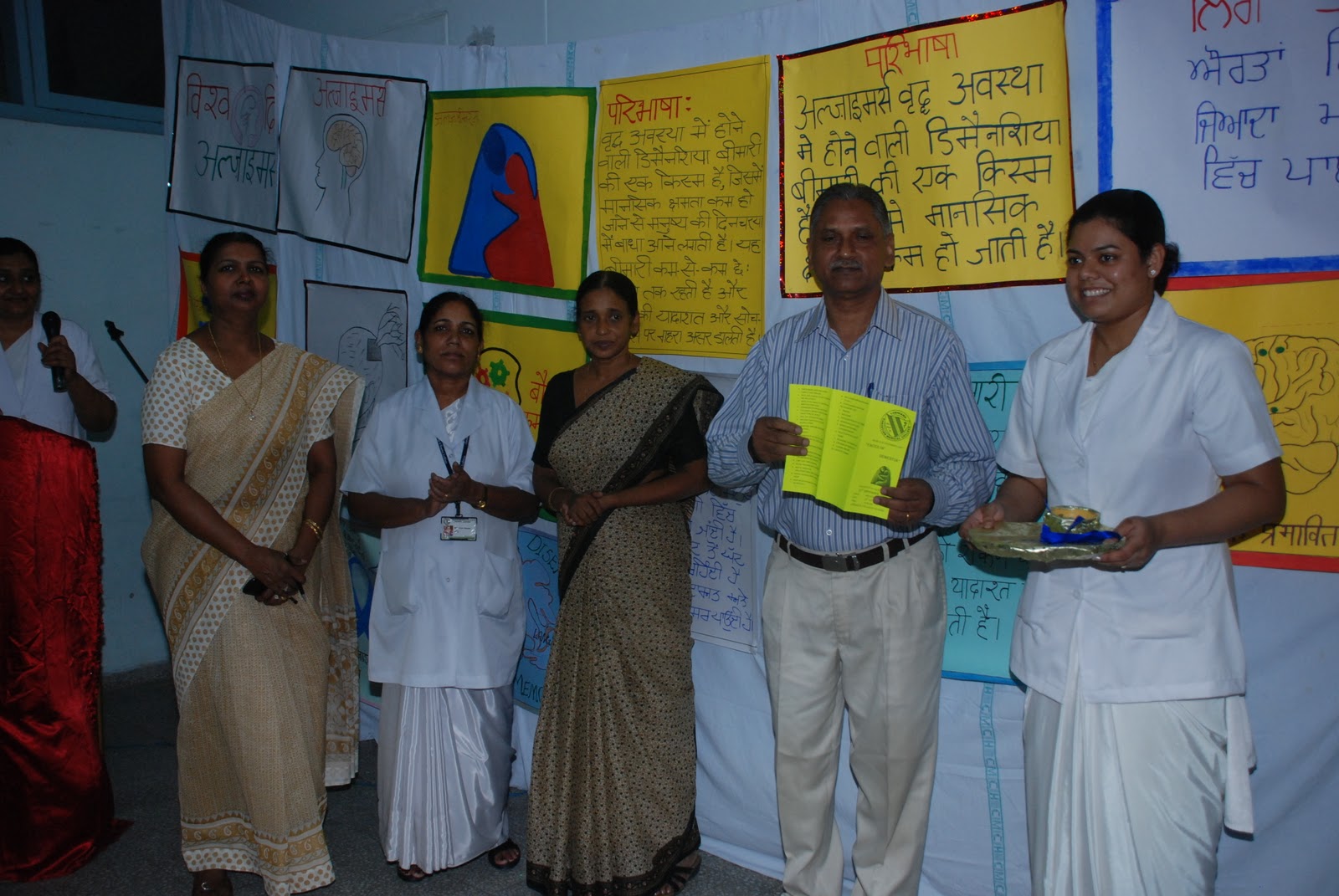
Students of M.Sc. (N) 1st year, College of Nursing, Christian  Medical College, Ludhiana, celebrated World Alzheimer’s Day on 21st September 2011, in Medical OPD. They had displayed large number of posters which covered all information regarding disease.
Chief Guest, Dr. Kim j. Mammen, Associate Director, appreciated the efforts of the students and explained about Alzheimer’s disease and told that there is a need to conduct more such programs to spread awareness.
Prof (Mrs)Triza Jiwan introduced the theme of the day ‘Faces of Dementia’ and explained that it is a degenerative disease of the brain in which there is memory loss and loss of mental ability severe enough to interfere with normal activity. 
Elderly people 60 years and above are affected. She emphasized on prevention of it, mentioning about having hobbies of art and music etc.
Principal and Coordinator Prof (Mrs) Ponnamma R. singh also shared her experiences. Dr. mamta, Associate Professor of Psychiatric department highlighted on importance of routine for such patients.
Prof (Mrs) Triveni Rajappa, Nursing Superintendent also marked her presence. Dr. kamal Masih, Medical Superintendent inaugurated the exhibition and released the pamphlets on Alzheimer’s disease and its care.
The program attracted the attention of more people as students of B.Sc. (N) 3rd year put up a role play on care of patients. Nearly 260 patients and their relative became aware of this disorder through the exhibition.: Shalu Arora and Rector Kathuria

Thursday, September 22, 2011

Vietnam Vet Still in the Fight


By Army Spc. Jennifer Andersson
159th Combat Aviation Brigade

KANDAHAR AIRFIELD, Afghanistan, Sept. 20, 2011 - Army Chief Warrant Officer 5 Roy Brown proved his mettle as a combat pilot in Vietnam. Now, 41 years later, he's proving his stamina and love of the military with service in Afghanistan.
Click photo for screen-resolution image
Army Chief Warrant Officer 5 Roy Brown, now serving in Afghanistan, stands with his helicopter in the early 1970s when he was Cobra pilot serving in Vietnam. Then, and now, Brown served with the 101st Airborne Division. Courtesy photo 
Brown, who also served in Operation Iraqi Freedom, began his career with the 101st Airborne Division, and is serving with the Screaming Eagles again as his career draws to a close. As the 159th Combat Aviation Brigade's liaison officer to the Air Force's 702nd Expeditionary Airlift Squadron, which supports Regional Command � South here, Brown is in no hurry to retire."Call it patriotism or call it my admiration of the Army's principles -- its organizational objectives and goals, its performance over the decades in areas not only of military success, but what I think of as social equity," he said. "But your life's works need to have a higher purpose."
Explaining how his career began, the Oklahoma native said it was a $5 bill that transformed his boyhood dream into reality in 1971.
"My mother asked me how I knew I wanted to be a pilot if I'd never flown, so I went to the local airport, paid $5 and rode in a Piper 140 airplane for about 20 minutes," he said. "Then I walked right into the Army recruiting office and said, 'Send me to flight school.'"
The recruiter told then-19-year-old Brown about a program called "High School to Flight School." Still in his first semester of college, he knew flight school was a good opportunity, so he took it. His mother had reservations about him going to war, but knew that flight school was something her son would never be afforded any other way.
"He always wanted to be a pilot, even when he was a little boy, playing with [toy] airplanes," his mother, Betty S. Terry-Schmidt, said. "It did not surprise me that he chose to be a pilot."
Following basic training at Fort Polk, La., Brown went on to primary flight school at Fort Walters, Texas, and advanced flight school at Fort Rucker, Ala. Even then, Brown was a force to be reckoned with. As the custom held on the day of a pilot's first solo flight, fellow students would throw the pilot into the local swimming pool.
"I evaded them successfully for about two hours, which, at that time, I think was a record," Brown said. "Then, of course, I was finally caught and thrown into the pool."
Brown proved to be an exceptional beginner pilot and graduated at the top of his class. This distinction earned him the privilege of choosing which air frame he would fly.
"I knew Vietnam was a hot and muggy place," he said. "There was one aircraft with air conditioning, so I went with the [AH-1] Cobra. Besides that, I knew if somebody shot at me, I could shoot back."
And choosing the Cobra guaranteed Brown would get shot at. "The question was not 'Who's going to Vietnam?'" he said. "If there was one or two not going to Vietnam, that was the unusual part. Everyone was going to Vietnam -- me, especially, when I chose the Cobra. That was 100 percent assurance you were going."
While Brown embraced the adventure on which he was about to embark, his mother struggled to temper her fears with the support she knew her son needed.
"As a mother, I was anxious. Not about him leaving, but about him going into war," Terry-Schmidt said. "I could understand his feelings, though. He was very determined, so I could only back him."
Rather than feeling fear or anxiety about heading to war, Brown chose to think positively. "We were apprehensive about what could happen in Vietnam," he said. "At the same time, we were young and bold, and we would be the ones to beat the odds."
While Brown beat the odds, not all of his buddies did, nor did the enemy. But despite the casualties he saw in Vietnam, he said he never experienced post-traumatic stress the way some veterans have. "I was young and naive enough that it didn't faze me," he said.
His job as a gun pilot was to take down the enemy by any means necessary, and he did his job. "Nonmilitary people don't understand, especially back in the days of Vietnam," he said, "and if you can't deal with that part of it, the military may not be a career path you should take."
"He was always a strong young man, and he knew what he had to do," Terry-Schmidt said.
Back at home, Terry-Schmidt had to endure long gaps in communication from Brown, with only the news to keep her informed. Sometimes it would be three weeks or longer before she'd hear from him.
"It would seem like forever," she said. "I was always anxious for his safety."
To keep her mind off the periods of no news from her son, she kept herself occupied.
"At that time, I was working, and I had younger children still at home, so in the daytime, I was busy," she said. "At night time, I would think of him, and of course, I did a lot of praying, trusting that God would take care of him and my prayers were answered."
Communication then was not like it is today, where soldiers can have contact with family and friends at most any time of the day, Terry-Schmidt said. This time around, she hears from her son a few times a week.
Improvements in communication have improved not only soldiers' morale, it also has improved how they fight wars, Brown said.
Throughout his career, he has become qualified on 11 types of aircraft -- both rotary and fixed wing -- some with multiple models, like the UH-1 Huey models B, C, D and H. He has deployed five times.
"I feel more confident with him being in Afghanistan than I did with him in Vietnam because of the experience he has now," Terry-Schmidt said. "I know he is a very careful pilot. He knows his abilities. I know he wishes he was not in Afghanistan, but that's where his duty has led him, and I respect him for that."

Wednesday, September 21, 2011

Sikhs are protesting against PM's Singh's Govt's policy


SIKHS TO HOLD "JUSTICE RALLY" DURING PM SINGH'S ADDRESS TO UN GENERAL ASSEMBLY

Sikhs for Justice (SFJ) announced that a "Justice Rally" will be held during PM Manmohan Singh's address to the UN General Assembly on September 24th from 9:00 am to 12:00 noon. Sikhs are protesting against PM's Singh's Government's policy of impunity towards Congress (I) leaders who organized and participated in the killing of Sikhs during November 1984.
In November 1984, thousands of Sikhs were massacred, their properties looted and burnt, all across India, with the active connivance of law enforcement and on behest of leaders of Congress Party Leaders. Kamal Nath, Amitabh Bachchan, Arun Nehru, Vasant Sathe, Jagdish Tytler and Sajjan Kumar, were seen instigating and leading the killer mobs that attacked Sikhs in November 1984. Twenty Seven (27) years after the massacre, PM Singh has failed to prosecute those responsible and instead have rewarded the killers of Sikhs with seats in the parliament and positions in the Cabinet.
According to attorney Gurpatwant S. Pannun legal advisor to SFJ, PM Singh is not only protecting Kamal Nath in India but is also actively working to get him immunity from prosecution before U.S. Federal Court where he is being tried for his role in November 1984 Sikh Genocide. PM Singh's Government has been sending Démarches to the U.S. Department of State seeking immunity from prosecution for Kamal Nath added attorney Pannun. While Indian Governments claims of democracy, human rights, justice and equality grow louder, bolder and loftier; its actions of shielding the human rights abusers defy the same.
SFJ along with victims of November 1984 have filed a class action law suit against Indian National Congress (Congress I) and Kamal Nath (SFJ v. INC. & Nath SDNY (10 CV 2940)) under Alien Tort Claims Act (ATCA) for their role in the killing of Sikhs in November 1984. US Court issued summons against Kamal Nath on April 06, 2010 while summons against Congress Party were issued in March 2011.

Tuesday, September 20, 2011

A press conference with Australian Minister

Secretary of Defense Leon E. Panetta, right, and Secretary of State Hillary Clinton, second from right, conduct a press conference with Australian Minister for Defense Stephen Smith, far left, and Australian Minister for Foreign Affairs Kevin Rudd after the U.S.-Australia ministerial talks at the Presidio in San Francisco, Calif., Sept. 15, 2011. The delegation met to discuss areas of mutual interest and to celebrate the 60th anniversary of the ANZUS Treaty, signed in 1951 by Australia, New Zealand and the United States. (DoD photo by Tech. Sgt. Jacob N. Bailey, U.S. Air Force/Released)

Monday, September 19, 2011

It was quite an eerie and spiritual moment


Mother's Heart Stopped During Marathon Open Heart Surgery

While Unborn Baby's Heart Kept Beating 
Rare Heart Surgery Saves Life of Mother and Child
Ludhiana, 19th September, 2011:(Shalu Arora) Mrs Gurpreet Kaur – a 25 y lady - w/o Mr Manmeet Singh r/o Kidwai Nagar Ludhiana was in a dire condition. The whole family had been overjoyed when Gurpreet had got pregnant . Then at the 28th week of pregnancy she started getting extremely short of breath. On examination it was found that one of her valves (the mitral valve) had got very tight. She was referred to Dr Harinder Singh Bedi – Head of Cardio Vascular & Thoracic Surgery at the Christian Medical College & Hospital , Ludhiana. Dr Bedi realized that due to the pregnancy Gurpreet’s blood volume had increased and so the valve which was already too small due to the disease was now functionally smaller as more blood had to pass through it. The blood was getting trapped in the lungs and so she was unable to breathe . Dr Bedi explained that this is like pulmonary edema where a patient basically drowns in her own blood . An intervention  procedure had been tried at another hospital but had failed . On admission to the CMC her condition was quite critical. She was also seen by the Head of Obstetrics Dr K Awasthi and Dr A Kellogg and a joint decision taken to perform an open heart surgery to save the mother and to let the baby continue growth in the womb. Dr Bedi told that any open heart surgery in a pregnant mother carries a high risk of miscarriage – but the surgery was essential to save the mother. With utmost care and continuous monitoring of the baby with special equipment - the delicate open heart surgery was done on 6th July 2011 . At surgery the mother’s heart was stopped – but the baby’s heart was allowed to beat normally and was monitored by a fetal monitor. Dr Bedi said that it was quite an eerie and spiritual moment to see the flat ECG of the mother and the normal beat of the baby . Anesthesia for this delicate case was given by Cardiac Anesthetist Dr Arun Gupta  . The heart lung machine was managed by Mr Jairus and Mr William who are among the senior most experts in this field . The other members of the team are Dr Allen, Dr Viju Abraham , Dr Paul , Dr Neharika , Dr Susan , Dr Miria and Dr Arjin  .
Gurpreet then recovered well and delivered a healthy baby boy on 9th Sep 2011 in the CMC by Dr Tapsaya Dhar Maseeh  who said that both mother and child are in the pink of health. Dr Bedi said that such cases are relatively rare . The first priority is to save the mother and also aim to have a normal baby. The whole CMC team was very happy that both mother and baby were well. Dr Abraham G Thomas – Director of CMC & H – told that a multi speciality care was essential for the appropriate management of such complex cases.

Thursday, September 15, 2011

C-130s Aid Wildfire Suppression Efforts


U.S. Northern Command
PETERSON AIR FORCE BASE, Colo., Sept. 14, 2011 - Six Department of Defense C-130 Hercules aircraft under the command and control of U.S. Northern Command continue to aid efforts to control wildfires in Texas, Oregon and Idaho at the request of the National Interagency Fire Center in Boise, Idaho, officials reported.
Click photo for screen-resolution image
A modular airborne firefighting system-equipped C-130 Hercules aircraft prepares for a run over a wildfire in Harrison County, Texas, Sept. 12, 2011. Four C-130 aircraft, assigned to the 302nd Air Expeditionary Group based at Austin-Bergstrom International Airport in Austin, Texas, dropped approximately 12,000 gallons of fire retardant onto two fires in northeast Texas. Courtesy photo 
The aircraft are equipped with U.S. Forest Service modular airborne firefighting systems.As of early today, DOD aircraft have completed the following missions in these states:
-- Texas: Fifteen drops delivering approximately 44,350 gallons of fire retardant;
-- Oregon: Two drops delivering about 2,700 gallons of fire retardant; and
-- Idaho: Two drops delivering approximately 2,760 gallons of fire retardant.
Units supporting the Texas operations are the 302nd Airlift Wing, Air Force Reserve, Peterson Air Force Base, Colo., and the 145th Airlift Wing, North Carolina Air National Guard. Both units are deployed to Austin/Bergstrom International Airport, Texas.
The support to the northwestern United States is being provided by the Wyoming Air National Guard's 153rd Airlift Wing, flying out of Boise International Airport, Idaho.
At the request of the Federal Emergency Management Agency, Northcom designated Randolph Air Force Base Auxiliary Field, Seguin, Texas, as a support base to assist in relief efforts.
�
Related Sites:
U.S. Northern Command

Wednesday, September 14, 2011

Amputee Earns 'Sergeant Airborne' Title


By Cheryl Rodewig
1st Infantry Division

FORT BENNING, Ga., Sept. 13, 2011 - Like thousands before him, Army Sgt. Joel Dulashanti donned an Airborne instructor black hat for the first time last month, signifying his completion of a detailed certification process with 1st Battalion, 507th Parachute Infantry Regiment.
Click photo for screen-resolution image
Army Sgt. Joel Dulashanti reaches for a harness strap during training on Eubanks Field at Fort Benning, Ga., in August 2011. U.S. Army photo by Cheryl Rodewig 
Unlike those before him, he met the standard with a prosthetic leg, a partial knee replacement and the aftermath of internal injuries suffered during an ambush in Afghanistan. With his wounds, he could have taken a medical discharge from the Army, but the paratrooper chose to stay in -- and to remain Airborne all the way."It's still brand new," he said, "but it feels good to actually have my hat."
Dulashanti's determination in the face of adversity, evident at the unit, will be instrumental in training Airborne students, said Army Command Sgt. Maj. Chip Mezzaline, battalion command sergeant major. More than 17,000 students come through the battalion each year.
"He's had a traumatic injury and had the resilience to stay on active duty and serve as an instructor in a position that's high-risk," Mezzaline said. "It's in his character -- something you can't teach. It's something inside him that's going to drive him to be successful in whatever it is that he's doing. I don't think 'can't' is in his vocabulary.
"Being a 'Sergeant Airborne' -- a 'black hat' -- at the Basic Airborne Course will inspire numerous students coming through here," he added.
Mezzaline said Dulashanti completed the instructor certification program at a level "above the standard." He trained on the lateral-drift apparatus, the mock towers, the 250-foot tower, the swing-landing trainer and the spin harness, and memorized a block of instruction for the mock tower exit.
"He's a paratrooper," Mezzaline said. "He comes from the 82nd Airborne Division. That Airborne career he probably thought was cut short, but this is new life for him here at the Airborne school. I predict within the next year he'll be a jumpmaster, probably a senior-rated jumpmaster, and he'll be doing door checks, exiting students at 1,250 feet above Fryar Drop Zone.
"And with his level of motivation, he'll probably move on to that next mark and be a centurion, which is 100 exits out of an aircraft," he continued. "The sky's the limit for Sergeant Dulashanti here at the 507th."
Dulashanti said he wants to do everything he can -- from jumpmaster to centurion -- while stationed here. A six-year veteran, he arrived at the battalion in May. Four years earlier, he was deployed as a sniper attached to the 73rd Cavalry Regiment. He remembers the details vividly.
"We were chasing two guys -- they were on a mo-ped together and we were in Humvees," he said. "They took off in the field and the sniper team went out. It was about 110 degrees outside, over 6,000 feet above sea level, and with no humidity -- all you could smell was the earth and burnt grass. As we were walking in this knee-high grass, I started to smell body odor, so I stopped and turned to my right in the direction of the odor. They began to engage in contact.
"They had AK-47s and they were lying in the prone about 10 meters away," he continued. "I took two rounds to my right knee. As I was coming out of the sun, I was shot through my left knee. As I was falling, the next round that came through went under my arm, through my ribcage and, since I was parallel to the ground, it traversed my entire abdomen down to my pelvis. That round was the worst. We returned fire, and those guys were finished."
Two platoons donated plasma to him before he was evacuated to the United States. Once he arrived at Walter Reed Army Medical Center in Washington, D.C., it took him eight months to be comfortable walking.
"The recovery process started off slow, [but] I accelerated fast," he said. "Most of the stuff can be replaced. I have a partial knee replacement on my left side. I have an above-the-knee amputation on my right side. I'm missing half of my stomach and 90 percent of my intestines and gall bladder, and half of my abdominal wall is gone."
He chose to stay in the Army in part for the fellow soldier recuperating alongside him in the hospital, he said.
"I had to set that example for the rest of the Army, just based on the fact they couldn't do it and they wanted to," he said. "Maybe in the future, somebody else will have an easier time getting to do stuff like this because I've done it already."
Since then, Dulashanti completed the Warrior Leader Course and the Advanced Leaders Course, among others. But his goal was to be part of Fort Benning's Airborne battalion.
"Mentally, I knew I could exit an aircraft, and I knew I was able to instruct people on how to exit an aircraft and to land on the ground properly," he said. "When I called about the job, the only question was, 'Can you jump out of planes?' and even though I hadn't done it, the answer was 'yes,' without a doubt. I knew I wouldn't be a safety hazard, so the answer was 'yes.'"
"It was pretty intense," Dulashanti said of the studying it took to pass the certification program, but other instructors helped him along the way.
"I have to kind of be on my 'A' game all the time," he said. "But at the same time, I do have limitations, so I have to make sure I take care of myself to prevent injury."
His "limitations" aren't something he tells every class of students about, but occasionally he mentions it or they find out. "Sometimes people ask me why I have a limp," he said. "I tell them I don't have a leg, so it's not really a limp."
His advice to other wounded warriors is simple: choose whether or not to have a positive outlook.
"Make up your mind," he said. "Everybody has to go through their own coping mechanisms. Sometimes you're in a denial state; when you come out of that denial state, then deal with what it is you have to deal with. Seek counseling if you have to. I never gave negativity even an opportunity to invade my mind. There was only one route for me in the first place."
�

Tuesday, September 13, 2011

Take Opportunity for Action in Sri Lanka

Amnesty International Urges Human Rights Council

Washington, DC:  In reaction to U.N. Secretary General Ban Ki-Moon’s transmission of the findings of his expert panel’s report on Sri Lanka to the Human Rights Council, Amnesty International said: 

"For months we have been waiting for the report’s findings to be presented to the Human Rights Council. Now there can be no more excuses for inaction or delays," said Sam Zarifi, Amnesty International’s Asia-Pacific director. 

The panel of experts report, made public in April 2011, found "credible allegations" of war crimes and crimes against humanity by all sides to the Sri Lankan conflict. 

"The panel of experts produced a strong, credible report - for the first time an international body acknowledged the extent of human rights abuses committed in the last days of Sri Lanka’s brutal conflict, when at least 10,000 civilians were killed," said Zarifi. "It’s time for the Human Rights Council to act on the panel of expert’s findings and hold those responsible for massive atrocities in Sri Lanka to account. The thousands of victims have waited long enough." 

Amnesty International also reminded the Human Rights Council of ongoing human rights abuses the organization has documented in Sri Lanka since the conflict ended in 2009. These include lack of humanitarian access to displaced communities, lack of consultation with communities in the resettlement process, and threats to media freedoms. 

Amnesty International is a Nobel Peace Prize-winning grassroots activist organization with 3 million supporters, activists and volunteers in more than 150 countries campaigning for human rights worldwide. The organization investigates and exposes abuses, educates and mobilizes the public, and works to protect people wherever justice, freedom, truth and dignity are denied. 

# # # 

Saturday, September 10, 2011

Haematology and BMT services are at a turning point


Ludhiana, 10th September,  Haematology, Oncology and Bone marrow transplantation services are at a turning point in our country with increasing number of patients requiring the need for these services.  With a projected increase in chronic diseases in India and increasing life span, patients with these diseases are on the rise.
The caregiver at the bedside has a very important role in the outcome of cancer patients. On this behalf Christian Medical College, Ludhiana conducted a unique national conference for the nurses and physician assistants working in the field of cancer and bone marrow transplantation. This is the first time in this region such a conference is held on the theme ‘Importance of Nursing care’focusing on ‘Quality, Competency and Research’.
This was attended by more than 300 delegates from 10 different states of the country and 25 different institutions.
The meeting was inaugurated by the Chief guest Dr Kim.J.Mammen and Dr Kunal Jain gave the welcome speech.
While Mrs Abanti Gopan from Kolkota spoke about quality in nursing care, Ms Swapna Joshi from TMH Mumbai, detailed on how to go about research in nursing care and Dr M Joseph John from CMC Ludhiana mentioned clinician’s view point on nursing care and emphasized that Indian nurses can be as good or better than nurses from abroad by giving adequate training more responsibility.
Ms Jyoti Sahni from PGI, Chandigarh talked about the infection control in specialized units and Ms Joylen Jonahs from Pune explained the details of managing central lines.  Mrs Selva Titus from Vellore expounded on the importance of filtration technology in Haematology-Oncology and transplant units to reduce the incidence of infections.
Ms Anita Desouza from Mumbai gave the details of maintaining a clean environment for BMT and leukemia units and Ms Margaret from Vellore gave the details of stem cell handling. Ms Deepshika Gupta from Ludhiana mentioned about the ways to prevent and manage extravasations.
Post lunch there were panel discussions on training avenues for nurses and physician assistants, attrition among nurses, optimal manpower in a specialized unit and maintaining interpersonal relationships in a unit. This was followed by quiz for the audience and organizing secretary Dr M Joseph John gave the vote of thanks.

Friday, September 09, 2011

Asmita weekend theatre workshop on Saturday

The Asmita weekend theatre workshop, conceptualised by Mr Arvind Gaur Director Asmita theatre group, is the first of its kind. This workshop provides working professionals a platform to pursue theatre on Saturday and Sunday mornings.
The uniqunes of this workshop lies in the selection of its content, chosen to study contemporary acting. Socio-political issues become a subject of discussions, improvisations and script reading.Voice and speech work, quintessential in acting are taught by means of physical exercises, street plays and monolouges.
15 years of knowledge and experience of Asmita Theatre Group is carefully filtered into the minds of students by the senior most actors of Asmita, under the critical guidance of Mr. Arvind Gaur.
Finally the three month workshop culminates in a public production.
"Kharashe" a play based on short stories by Gulzar was performed by the second batch of Asmita Weekend Theatre Workshop at I.H.C on the 26th and 27th of july.A comprehensive documentation of this play is available at the Asmita Weekend Theatre Group on Facebook.

For More Details Contact: Shiv Chauhan-9958793683,Shilpi Marwaha-9540656537, Arvind Gaur-9899650509

8th Ophthalmic Quiz organized


Ludhiana, 9th September: The Department of Ophthalmology, Christian Medical College and Hospital successfully organized the 8th Ophthalmic quiz for undergraduate medical students in the hospital auditorium on 9th September 2011. The Chief Guest for the occasion was Dr.A.G.Thomas, Director, CMC & Hospital. He encouraged the participating teams and appreciated the efforts of the department in making this academic venture a much awaited annual feature of the institution.
Among the 30 undergraduate teams, 5 teams qualified for the quiz following the preliminary round. Dr.Nitin Batra and Dr.Gurvinder Kaur conducted the finals. Anjali B Susan and Anu Sara Philip (Batch of 2008) were the winner & Nayana Sebastian and Dona George (Batch of 2006) were the 1st runner up.
Dr.S.M.Bhatti, Principal CMC, was the guest of Honour and presented a special Award of Merit to an outstanding student, Geetika Gera (Batch of 2007). Gayatri Bhatia (Batch of 2008) presented an interesting talk titled ‘Hall of Fame’, which gave a brief history of legendary ophthalmologists.

Soldier Recalls Helping New York Citizens During 9/11


By Stephanie Hoff
1st Infantry Division
FORT RILEY, Kan., Sept. 7, 2011 – A decade ago, then-paramedic Peter Rosie was on his day off hanging around his apartment in New York City.
Click photo for screen-resolution image
Army Staff Sgt. Peter Rosie with the 1st Infantry Division pulls security duty during his unit's deployment to Iraq in 2009. Rosie had served as a civilian paramedic with the New York City Fire Department during 9/11. Courtesy photo   
Rosie was in his eighth year with the New York City Fire Department, where he served the residents of the Harlem community. A phone call from his girlfriend instructing him to turn on the television caused Rosie to spring into action.
"I saw the first plane hit [the North Tower] on the TV. We had a small TV so you couldn't make out the magnitude of it," Rosie recalled. "All I had to do was walk one flight to the roof, and then I saw the second [plane] hit in front of me. My first thought was, 'I better go to work.'"
Today Rosie is an Army staff sergeant serving here with the 1st Infantry Division’s 1st Battalion, 4th Cavalry Regiment. On Sept. 11, 2001, he experienced the horror of the terrorist attacks on the World Trade Center’s Twin Towers.

Rosie is native of Scotland who’d previously served in the U.S. Army and later with the British Army before joining the New York City Fire Department. On 9/11, he hopped on his son's bicycle to report to Bellevue Hospital Center. Throughout the following
Weeks, the facility would be one of New York's busiest centers to treat the wounded and later assist with identifying the deceased.
Within 10 minutes Rosie was handed a two-way radio and assigned to a partner and an ambulance for assistance at the World Trade Center.
"They threw a radio at me and said 'Here's your partner' and we started going down [to the WTC]," he said. "All I knew was it was bad."
He would soon be a first-hand witness to the sheer magnitude and danger of the day's tragic events when his ambulance began to arrive on the scene just as the South Tower [the first of the two towers to collapse] began to fall and nearly struck his vehicle.
"We were driving into it as it was coming down. We're talking seconds,” he said “If we had been a little bit earlier -- goner. Then, it just went black."
Rosie recalled that the closer they traveled to what is now known as "ground zero," the harder it became to keep their bearings due to the amount of smoke and falling debris. The first patients he assisted included a police officer suffering from a heart attack and another person who’d lost a limb.
"It was that first transport that was the worst," he said. "We backed up into Bellevue and there's just a sea of scrubs, just people waiting.”
When Rosie returned to the site, the second tower had also collapsed and he recalled how first responders were still attempting to establish a command post and a means of communications between emergency personnel.
"By that point, no one knew what was going on,” he said. “We were hearing and getting all kinds of information. At one point we thought the Holland Tunnel was blown up."
Rosie recalls he functioned on “auto-pilot” the rest of the day and ensuing night, with numerous patient transports to the hospital and treating patients’ respiratory distress and eye injuries.
He recalled that smoke would continue to rise from the site for weeks and by then emergency crews had switched from rescue missions to recovery missions to retrieve the deceased from the debris.
For the following year when Rosie wasn't on his scheduled shift at the fire department, he would be found volunteering for recovery missions at ground zero.
"For the next year if I wasn't working at Harlem, then I was working down at ground zero," he said. "There was a lot of camaraderie. It was good, but tiring.”
There were 343 New York City firefighters who’d lost their lives on 9/11, Rosie said. His experiences during 9/11 in New York City caused Rosie to eventually rejoin the U.S. military.
"I knew that everything had changed,” Rosie said, “and I wanted to go back into the Army."
Unfortunately, Rosie’s age was working against him. He was over the Army's maximum enlistment age. However, as though fate granted his wish, the policy was temporarily changed. Rosie again donned a U.S. Army uniform after nearly 26 years.
"I guess they were getting hard up and taking old men," he chuckled. Four years later, Rosie finds himself assigned to the historic 'Big Red One' here, preparing to embark on his third deployment with the 4th Infantry Brigade Combat Team.
"I thought I had bit off a little more than I could chew initially. But I persisted and I ended up doing real well," Rosie said of his success in achieving the rank of staff sergeant after returning to the Army as a specialist.
Rosie visited New York this July. The trip, he said, marked the first time he’d returned to the city since re-enlisting in the Army.
"I don't think about Sept. 11 too much,” he said. “I'm not sure if it's some sort of coping mechanism, but I think it's why I never went back to New York [before].” 
Related Sites:
Special Report: Remembering 9/11
First Infantry Division and Fort Riley

Thursday, September 08, 2011

Survivor Supports Families in Wake of 9/11


By Elaine Sanchez
American Forces Press Service

WASHINGTON, Sept. 6, 2011 - It's been a decade since American Airlines Flight 77 struck the Pentagon on Sept. 11, 2001, but Bonnie Carroll vividly recalls the aftermath.
Click photo for screen-resolution image
Bonnie Carroll, president of the Tragedy Assistance Program for Survivors, assisted family members of the fallen in the wake of the terrorist attack on the Pentagon on Sept. 11, 2001. TAPS provides resources and support to family members with a fallen military loved one. Courtesy photo 
As a family-support volunteer, she spent hours "listening and sharing" with families who were waiting to be notified about a missing loved one.Carroll, president of the Tragedy Assistance Program for Survivors, was among a team of volunteers who responded in the wake of the devastating terrorist attack that took 184 lives at the Pentagon.
That day "changed everything about the world in which we live," she said. "It gave every American an appreciation of those on the front line protecting freedom -- a renewed sense of appreciation."
Carroll was at home in Anchorage, Alaska, when the news broke about the terrorist attacks here and in New York, and she immediately felt compelled to help -- both as an Air Force reservist and as the president of TAPS. She had founded this organization to offer support to survivors of fallen military loved ones after her husband, Army Brig. Gen. Tom Carroll, died in an Army C-12 plane crash in 1992.
In her reserve capacity, she was assigned to the Pentagon's office of national security and emergency preparedness and had just wrapped up reserve duty there and returned home. But when she heard the news, she put on her uniform and was on the first plane out of Alaska.
Carroll put a call out to her TAPS peer mentors to come to Washington at their own expense to help. More than 200 responded in a "tremendous response," she said. She arranged to have them serve six to 10 at a time in weeklong shifts offering 24/7 support to family members in the Pentagon Family Assistance Center at Crystal City's Sheraton Hotel in Virginia.
The center opened the morning of Sept. 12 and remained open around the clock until Oct. 12, helping both Defense Department victims' families and families of the passengers aboard Flight 77. Along with TAPS volunteers, the center was staffed by military community and family policy specialists, plus thousands of volunteers.
"We had folks who were surviving family members there to just be a comfort, to sit and hold hands," Carroll said. "We had really, really tremendous people who stepped forward.
"It was just beautiful," she added. "So much healing took place in that little closed environment. So much love and care and support, and the bonds that were formed exist to this day."
To avoid burnout, Carroll scheduled the volunteers in one-week blocks so the peer mentors and survivor support team were "alert, fresh and ready," she said.
"A big part of the effort ... was providing tremendous care to those 500 families at center, but also care to our team members who also were survivors," she noted.
The organization also brought in grief and trauma experts from around the nation. "We were focused on getting the best, most appropriate support in place that would complement the support provided by the DOD," she said.
In time and as reports rolled in, Carroll said, the atmosphere of hope shifted into a time of solace and support.
Twice a day, she recalled, now-retired Army Gen. John A. Van Alstyne, then deputy assistant secretary of defense for military personnel policy, briefed the families and take their questions.
The general offered families a fact-based, sometimes graphic briefing, and on some days, asked everyone to stand up and sing "God Bless America," Carroll said. And then "he would remind everyone to breathe. People didn't realize they were holding their breath."
Carroll said the general often remarked, "Regardless of their job -- whether a contractor, DOD civilian or military member -- the day of their death, they were on duty for America."
Carroll vividly recalls the family members she met and their reactions in the aftermath of the attack on the Pentagon.
She remembers standing in the hall with Pat Hogan, an Air Force doctor who lost her Army major husband in the Pentagon. They were talking, when then-Army Chief of Staff Gen. Erik K. Shinseki and his wife, Patricia, walked up.
Carroll said Hogan looked Shinseki in the eye -- just days after her husband had been killed -- and said, "I have no children; I have no husband. Nothing is holding me back. I want to transfer to the Army and I want to go to the front lines."
"I would have thought he would have patted her on the head and told her to take time to grieve," Carroll said, choking up. "But he said, 'You got it.'"
However, the Air Force chief of staff at the time, now-retired Gen. John P. Jumper, got wind of the conversation and asked her to stay in the Air Force. He said he'd send her with pararescue personnel to Afghanistan so she could serve as their doctor.
"She left soon after," Carroll said. "She's amazing."
Carroll also recalls the Hemingway family from Kansas, who lost their son, a father of two.
"They hung in there all day every day for six weeks," she said, "and then they were the last family to be told that nothing of their son could be identified. There was nothing found."
After six weeks, the support center closed down, Carroll said, but TAPS volunteers continued to support the families of the fallen -- the same mission that continues today. The organization's support includes peer-based emotional support, a 24/7 help line, support groups, seminars and one-on-one counseling.
In turn, many of the 9/11 surviving family members became staunch supporters of TAPS, she said. Lisa Dolan, whose Navy husband died in the Pentagon, started a therapy dog program for TAPS' Good Grief Camp, which offers support to children of fallen service members.
Another survivor, Joyce Johnson, who lost her husband, works for TAPS as part of the adult survivor support team, which reaches out to those with newly lost loved ones.
Their contributions speak to their resilience, she said, as well as the resilience of the nation.
This year marks a decade since the tragedy occurred, but Carroll said Americans are reminded of the attacks every day.
"Every time we go through airport security or see a flag-draped coffin on the front page of the paper, every time we hear about security concerns," she said, "we're reminded of where this journey began and the precious nature of our freedom and the fragile world in which we live."
�
Related Sites:
Tragedy Assistance Program for Survivors

Wednesday, September 07, 2011

AN APPEAL for PEMA from LEH

Pema is 30-year old lady from Leh, Ladakh, with four children, who recently underwent a urinary bladder reconstruction operation in the Department of Urology, Christian Medical College & Hospital, Ludhiana. She had a diseased urinary bladder which was small in capacity and could not store urine due to tuberculosis of the kidney and bladder. Her left kidney was also diseased and non-functioning due to tuberculosis. Her right kidney was also obstructed due to tuberculosis and this was also set right surgically.

Pema had urinary incontinence and she was always wet and stinking with the smell of urine. Her clothes were always wet due to dribbling of urine without her knowledge. It was an embarrassment for Pema to meet her friends & family, and she could not move out of her home. She then decided to come to CMCH for further treatment. Dr Kim Mammen, Professor & Head, Department of Urology, CMCH

, and his team of doctors and Nurses performed reconstruction of the urinary bladder using an intestinal segment and increased its capacity to store more volume of urine for curing her urinary incontinence. As she was recovering from this major surgical procedure, she developed weakness of all her four limbs due to tuberculosis affecting a portion of her brain, making her unable to walk and use her hands. She is on treatment for her TB and on rigorous physiotherapy and rehabilitation therapy to get the function of her limbs back to near normal. Doctors, Nurses and Physiotherapists at the CMCH are working very hard to get Mrs Pema back to normal. Her husband went back to Leh, Ladakh, to sell all the jewelry and household assets to bring some more money for Pema’s treatment. The hospital authorities have subsidized her treatment and given her a lot of financial assistance, writing off a significant portion of her escalating treatment bill.


Her total cost of treatment would come to Rs 2.5 Lakhs. Pema and her husband had come to CMCH from Leh with only Rs 30000.00

and nothing more. This was the maximum amount they could collect from contributions from their family and friends. Kind hearted philanthropists and well-wishers can help this poor and truly deserving lady by sending in their contribution to the Medical Superintendent, CMCH, by a crossed cheque in favor of “CMC Ludhiana Society” with PEMA’s name and C/O Urology Department mentioned at the back of the cheque, along with a covering letter. All contributions are exempt from income tax under Section 80 G of the Income Tax act. 


Dr Kim Mammen,

Professor & Head, Department of Urology,
Christian Medical College & Hospital,
Ludhiana-141008, Punjab.
Mobile: +91 9814034185.

Friday, September 02, 2011

Senior Defense Leaders Meet in Chile


U.S. Southern Command News Release
SANTIAGO, Chile, Sept. 2, 2011 - Military and civilian defense leaders from a dozen Western Hemisphere nations met here from Aug. 31 until yesterday to discuss future military support for humanitarian assistance and disaster relief missions in the region.
Click photo for screen-resolution image
From left, U.S. Air Force Gen. Douglas Fraser, commander of U.S. Southern Command, Chilean Defense Minister Andr�Allamand, Chilean President Sebastian Pi� and Chilean Army Lt. Gen. Hern�Mardones, chief of the Chilean Armed Forces' Joint Staff, join senior military and civilian defense leaders from 10 nations during a meeting hosted by the president at his executive office in Santiago, Chile, Aug. 31, 2011. The leaders were in Chile to attend the 3rd Annual South American Defense Chiefs Conference, held Aug. 31 to Sept. 1, 2011. Photo courtesy of the Chilean Joint Staff of the Armed Forces 
The leaders gathered during the 3rd Annual South American Defense Chiefs Conference, co-hosted by the Joint Staff of the Chilean Armed Forces and U.S. Southern Command.U.S. and Chilean representatives were joined by counterparts from Argentina, Bolivia, Brazil, Colombia, Ecuador, Mexico, Panama, Paraguay, Peru and Uruguay, as well as observers from U.S. Northern Command, the Inter-American Defense Board and Center for Hemispheric Defense Studies.
Chilean Defense Minister Andr�Allamand joined Air Force Gen. Douglas Fraser, Southcom's commander, and Lt. Gen. Hern�Mardones, chief of the Chilean Armed Forces, in delivering opening remarks during the event commencement.
This year's conference included briefings, roundtable discussions and meetings focused on improving collaboration and coordination among regional defense forces assisting civilian agencies during international relief missions.
The focus of this year's conference supports an initiative announced by senior civilian defense leaders in November 2010 during the IX Conference of Defense Ministers of the Americas held in Santa Cruz, Bolivia. The initiative calls for the development of a common-technology platform to facilitate information sharing and a military assistance collaboration cell to enhance the interoperability of regional armed forces supporting civilian emergency response agencies in future humanitarian assistance and disaster relief missions.
In response to the ministerial announcement, regional defense leaders and experts conducted working groups in Lima, Peru, and San Jose, Costa Rica, to develop a framework and explore implementation options for the initiative.
"This conference will allow us to support the multinational military coordination efforts of the working groups," Fraser told attendees prior to the start of the conference.
With that aim, participants also examined lessons learned during prior missions, explored improvement opportunities, and considered recommendations to further the goals of the Santa Cruz conference initiative.
Air Force Brig. Gen. Steven Shepro, director of Southcom's strategy, policy and plans directorate, briefed attendees on U.S. humanitarian assistance and disaster relief collaboration efforts and described the varying levels of interagency and multinational integration observed during past operations.
"The folks in the field naturally jump into coordination and collaboration," Shepro explained, adding that similar cooperation and coordination at the operational and strategic levels -- where interagency and multinational planners are often geographically separated -- is more challenging to jumpstart.
Because a common technology platform would facilitate greater information sharing and potentially improve coordination and collaboration at all levels, many conference participants expressed their support for further developing the concept and implementing it during future exercises and operations.
Though exactly what the platform will look like and how it will be managed has yet to be determined, the working groups have identified what users will want, Shepro said.
"I think the consensus of the [working] groups ... is that it be participant based ... and meet their level of comfort to report what assets they can provide and to provide their understanding of the situation," he said.
Speaking to his counterparts about the Santa Cruz meeting's agreement to establish a military assistance coordination cell, Fraser shared his perspective about the cell's potential role in future multinational humanitarian assistance and disaster relief operations. Fraser proposed that the cell not be permanent, but have protocols allowing for its activation and deployment to support militaries in countries impacted by disasters when their government's request for international assistance includes military components.
"Dealing with a disaster within a country is a full-time job for each of us," Fraser said. "And to have a cell that can take some of the load off, but provide capacity as required, is very beneficial."
Ideas and recommendations proposed in this year's South American Defense Chiefs Conference will be shared with future working groups, who will use the input to formulate proposals for regional defense ministers to consider during the next conference in 2012.
The South American Defense Chiefs Conference is one of three regional security conferences sponsored by Southcom each year to provide forums for dialogue and exchanges among defense and security leaders from the Caribbean, Central America and South America.
This year's conference in Santiago follows previous conferences with defense and security leaders from Central America and the Caribbean in San Pedro, Belize and Port of Spain, Trinidad.
�
Biographies:
Air Force Gen. Douglas E. Fraser 
Related Sites:
U.S. Southern Command 
News Release 

Sunday, August 28, 2011

Airman Honors Vets Via Baseball


By Jose T. Garza III
502nd Air Base Wing

LACKLAND AIR FORCE BASE, Texas, Aug. 24, 2011 - Air Force Staff Sgt. Craig LeBlanc said the opportunity to honor U.S. veterans and meet with baseball heroes during a near month-long journey from New Orleans to ground zero in New York City earlier this year was an experience he'll never forget.
Click photo for screen-resolution image
Air Force Staff Sgt. Craig LeBlanc, who was a member of the "Heroes of the Diamond" baseball club earlier this year, stands alongside U.S. Navy veteran Everett Swanson, a survivor of the Dec. 7, 1941, attack on Pearl Harbor that caused America to enter World War II. LeBlanc is a military training instructor assigned to the 331st Training Squadron at Lackland Air Force Base, Texas. Courtesy photo 
LeBlanc, an instructor assigned to the 331st Training Squadron here, was selected as one of several military ambassadors for the "Heroes of the Diamond" club, a national team chartered with promoting goodwill and military awareness through the sport of baseball."It was truly a privilege," LeBlanc said about playing on the HOD team. "I was given the freedom to play baseball, and it was an honor to represent the Air Force. I know what the flag means to me and what it represents. I'm proud to be wearing the red, white and blue."
Team members began their tour Jan. 1 from New Orleans. They traveled to Philadelphia and several other cities, where they displayed the ground zero flag to thousands of Americans, including service members who have served in Iraq and Afghanistan.
Though LeBlanc since has returned to his instructor duty, the team continues its journey across the United States. It's scheduled to arrive at its final destination in New York on Sept. 11, officials said. There, at the site of the former World Trade Center towers, the flag will be presented and permanently displayed.
As a military ambassador for the HOD, LeBlanc met several baseball legends at the Baseball Hall of Fame in Cooperstown, N.Y., including Pete Rose, Ozzie Smith and Yogi Berra.
"Meeting Yogi Berra was one of the coolest times ever," LeBlanc said. "He is a baseball legend, and it is not every day you get to shake the hand of a baseball legend."
The tour also provided opportunities to meet with military veterans, and families of the fallen from the 9/11 attacks, LeBlanc said. Hearing their stories, he said, made him realize how fortunate he is.
"I always tell my wife and kids that I love them," LeBlanc said. "Life is too precious to let it go to waste."
LeBlanc said he was proud to be wearing the red, white and blue on his chest as part of his HOD baseball uniform. Every player on the team, he added, wears a number that represents a historic day or figure in American history.
"I wear No. 21, which represents the Tomb of the Unknowns [at Arlington National Cemetery]," LeBlanc said.
Cutting the trip short and returning home before this year's 9/11 observance in New York City was difficult, he said, but duty called and airmen must place service before self, he added.
�